An Introduction to Africana Philosophy
Lewis Gordon’s undergraduate textbook, the first full treatment of Africana philosophy, tracing an African diasporic consciousness from the Afro-Arabic world of the Middle Ages.
Ẹ̀rọ ló túmọ̀ díẹ̀ lára ọ̀rọ̀ ojú-ìwé ní èdè yìí, a sì ń yẹ̀ ẹ́ wò lọ́wọ́.

Lewis Gordon’s undergraduate textbook, the first full treatment of Africana philosophy, tracing an African diasporic consciousness from the Afro-Arabic world of the Middle Ages.
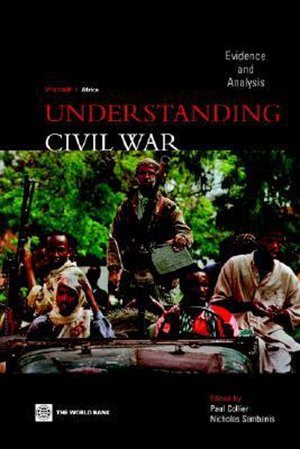
World Bank case studies edited by Paul Collier and Nicholas Sambanis (2005), testing an economic model of why civil wars begin; the Africa volume covers countries such as Burundi, Congo, Nigeria, Kenya, Mozambique and Sudan. Which volume this copy is still needs checking.
According to World Bank figures (World Development Indicators, as checked for the CCAF Origins Atlas in October 2026), Algeria is Africa’s largest country by surface area, about 2.38 million square kilometres, closely followed by the Democratic Republic of the Congo and Sudan. Nigeria is the most populous, with about 238 million people in 2025, followed by Ethiopia and Egypt. Population figures are estimates and change every year.
Timbuktu, in present-day Mali at the edge of the Sahara, was an intellectual and spiritual capital in the 15th and 16th centuries, with the Sankore university and many Qur’anic schools. It was also a market where salt, gold, cattle, grain and manuscripts were traded. Its three great mosques, Djingareyber, Sankore and Sidi Yahia, recall this golden age. UNESCO notes that the monuments, though regularly restored, are threatened by desertification.
The land between the Nile and Atbara rivers in present-day Sudan was the heartland of the Kingdom of Kush, a major power from the 8th century BCE to the 4th century CE. Its rulers governed Egypt for close to a century. From the 3rd century BCE, Meroë was the royal city and the main royal burial place, with pyramids, temples, palaces and water-management works. Kush exchanged art, architecture, religion and language with the Mediterranean world and inner Africa.
Kilwa Kisiwani, on an island off the coast of Tanzania, was one of the great Swahili port cities. It reached its height in the 13th and 14th centuries, when gold and ivory from the interior were traded across the Indian Ocean for goods from Arabia, India and China. Kilwa minted its own coins from the 11th to the 14th centuries. The traveller Ibn Battuta visited in 1331–1332. Its decline began after the Portuguese built a fort there in the 16th century.
In the mountains of Ethiopia, eleven medieval churches were hewn out of the living rock rather than built from blocks: doors, windows, columns and roofs were all cut from the same stone, with trenches and passages between them. Their making is attributed to King Lalibela, who sought to create a ‘New Jerusalem’; UNESCO dates them to the 12th–13th centuries. Lalibela remains a living place of Ethiopian Christian pilgrimage.
Aksum, in the highlands of northern Ethiopia, was the centre of a kingdom that UNESCO dates from the 1st to the 8th century CE. It traded across the Red Sea through the port of Adulis and was among the most powerful states between the Eastern Roman Empire and Persia. Its monuments include carved stone stelae, the tallest still standing over 23 metres. Stone inscriptions of King Ezana from the 4th century use Greek, Sabaean and Ge’ez, the classical language of Ethiopia.
Great Zimbabwe, near Masvingo in present-day Zimbabwe, is the stone-built capital of a Shona state. UNESCO dates its building to about 1100–1450 CE. The site has three parts: the Hill Ruins, long considered a royal centre; the Great Enclosure, an elliptical wall of cut granite from the 14th century; and the Valley Ruins. Great Zimbabwe was an important trading centre. A legend linking it to the Queen of Sheba is only a legend: the city is the work of the Shona people’s ancestors.
The SKA Observatory is building two of the world’s largest radio telescopes. SKA-Mid is in South Africa and SKA-Low is in Australia; the observatory’s headquarters is at Jodrell Bank in the United Kingdom. Hosting SKA-Mid makes South Africa one of the two homes of this global radio-astronomy project, alongside Australia.
Correct Connect Africa Foundation · 20B Muyibat Oyefusi Crescent, Omole Estate Phase 1, Ikeja, Lagos, Nigeria · info@ccaf.africa